


In Waves and War…
Could We Be Looking at One of the Biggest Mental Health Breakthroughs of Our Lifetime?
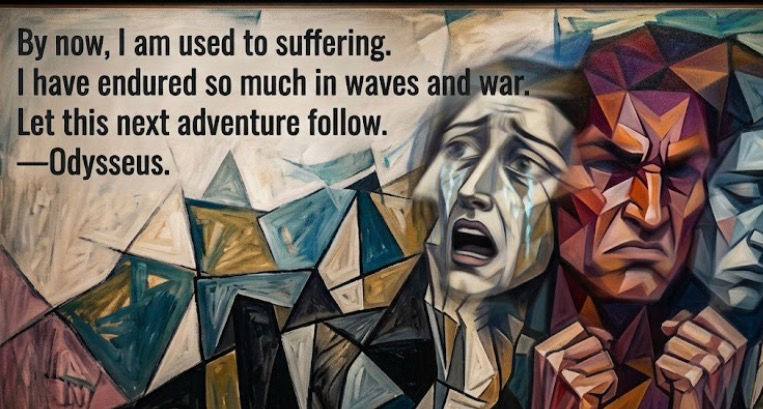
“ I am used to so much suffering. I have endured so much in waves and war. Let the next adventure follow.” —-Odysseus
(the Odyssey)
I rarely tell people to stop what they're doing and watch a documentary.
I'm telling you now.
If you have struggled your entire life with anger, depression, addiction, rage, shame, despair, childhood trauma, sexual abuse, or emotional pain that never seems to leave, I want you to watch the Netflix documentary In Waves and War before you dismiss what I'm about to say.
For years, I have taught that our childhood shapes much of who we become as adults. We carry invisible wounds into our marriages, careers, friendships, and relationships with our children. We often spend decades treating the symptoms while never addressing the wound itself.
This documentary made me stop and think.
Mike Tyson
Most people know Mike Tyson as one of the most feared heavyweight champions in history.
But very few people remember the child before the champion.
Before the age of twenty:
He grew up in one of the roughest neighborhoods in Brooklyn.
His father abandoned the family.
He was bullied as a child.
He was repeatedly arrested as a juvenile.
He has publicly discussed being sexually abused as a child.
His mother died when he was sixteen.
Boxing trainer Cus D'Amato eventually became the father figure he had never known.
Then the world watched Mike Tyson become "Iron Mike."
We also watched years of rage, violence, legal troubles, addiction, broken relationships, and public meltdowns. After his highly publicized marriage to Robin Givens ended, many people simply concluded that Tyson was an angry, dangerous man.
That became his identity.
Then something changed.
Several years ago, Tyson began speaking publicly about his experiences with psychedelic therapy, including 5 MeO DMT. He described what many refer to as an "ego death," saying the experience fundamentally changed how he viewed himself, his family, and even death itself. People who followed his career noticed a remarkably different man. Instead of constant rage, they heard compassion. Instead of bravado, they heard humility. Instead of bitterness, they heard a father speaking lovingly about reconnecting with his children.
The Veterans
The Netflix documentary In Waves and War follows former Navy SEALs suffering from severe post traumatic stress disorder, traumatic brain injuries, depression, anxiety, addiction, and broken relationships after years of combat.
Many had tried years of therapy.
Many had tried medication.
Many believed they were beyond help.
The documentary follows their treatment with ibogaine and 5 MeO DMT in medically supervised settings outside the United States.
What struck me was not simply that some of these men reported fewer symptoms.
Their wives described them as different people.
Their marriages improved.
Their children noticed a difference.
Some of the veterans began talking openly about childhood wounds that existed long before they ever went to war.
The battlefield may have intensified their suffering, but it was not always where the suffering began.
Jordan Peterson's Observation
One of the most fascinating comments I have heard came from Dr. Jordan Peterson during his interview with psychedelic researcher Dr. Roland Griffiths of Johns Hopkins University.
Referring to the clinical research, Peterson remarked:
"It is simply unprecedented in psychiatry that a single dose of a medicine produces these kinds of dramatic and enduring results."
Think about that statement.
A psychologist who has spent decades studying depression, trauma, addiction, and personality is describing these findings as unprecedented in psychiatry.
That does not mean psychedelics are a miracle cure.
It does not mean everyone experiences the same results.
It does not mean these treatments are appropriate for everyone.
What it does mean is that some carefully conducted clinical studies have produced improvements that many experienced researchers never expected to see.
What If We Have Been Treating the Wrong Problem?
This is the question I cannot get out of my head.
What if anger is not the disease?
What if addiction is not the disease?
What if depression is not the disease?
What if, for many people, those are symptoms of something much deeper?
What if the real wound is unresolved trauma...
...childhood shame...
...sexual abuse...
...neglect...
...the belief that we are fundamentally unworthy of love?
If that is true, then perhaps healing does not begin by suppressing symptoms.
Perhaps it begins by confronting the wound that created them.
That possibility is exactly why researchers are paying such close attention to these treatments.
My Recommendation
I am not telling anyone to run out and seek psychedelic therapy.
I am telling you to become informed.
Watch In Waves and War.
Listen to Dr. Jordan Peterson's interview with Dr. Roland Griffiths.
Read the research.
If you have spent your entire life battling depression, rage, addiction, unresolved childhood trauma, shame, sorrow, or despair, you owe it to yourself to understand what researchers are discovering.
Whether these therapies ultimately become a standard part of mental health treatment remains to be seen.
And that is something worth paying attention to.
Sg


Comments